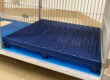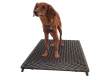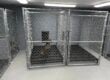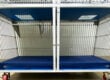
RACS kennel floors are built for the operational reality of commercial boarding and daycare: high animal volume, constant turnover, and a surface that has to deliver the same standard of comfort and sanitation at full capacity that it did when the doors opened. If you’re running a boarding facility or daycare, the flooring decision isn’t about what looks clean after one dog. It’s about what stays clean, comfortable, and functional after dozens of dogs have used the same runs today.
Most boarding facility flooring forces a trade-off that facility owners have learned to live with. Soft surfaces feel comfortable but absorb bacteria and odor under heavy use. Hard surfaces sanitize easily but leave dogs lying on cold, unforgiving material. The industry has accepted that compromise for decades, and most flooring decisions are really just choosing which problem you’d rather manage. RACS raised kennel floors eliminate it. Plastisol-coated steel doesn’t absorb, doesn’t conduct cold, and doesn’t degrade under the kind of daily volume a commercial facility puts on it.
The Floor That Works at 8 AM Isn’t the Same Floor at 5 PM
Flooring in a high-volume boarding facility takes a beating that residential kennel floors never see. Dogs cycle through runs all day. Fluids accumulate. Cleaning products get applied and rinsed repeatedly. By late afternoon, the floor has absorbed hours of use, and the surface quality has changed.
Rubber mats are the clearest example. They’re comfortable when new and easy enough to hose down between dogs. But rubber is porous at the molecular level. Over weeks and months of heavy use, moisture, odor, and bacteria embed in the material in ways that surface cleaning can’t fully reverse. A rubber mat that smelled fine in January doesn’t smell fine in July, and the dogs lying on it can tell the difference even if the staff can’t.
Sealed concrete has the opposite problem. It’s durable and sanitizable, but it stays wet between dogs because drainage depends on staff with squeegees. In a facility running at capacity, there isn’t always time to dry every run between turnovers. Dogs end up lying on damp concrete, which pulls heat from their bodies and creates the exact conditions bacteria thrive in.
Epoxy and tile hold up better than rubber in the short term, but they introduce their own failure modes under daily commercial use. Epoxy scratches from nail traffic, and each scratch becomes a harboring point that cleaning passes over. Tile grout lines absorb moisture and bacteria no matter how often they’re scrubbed. Both surfaces require maintenance cycles that take runs out of service, and in a facility where every run represents revenue, downtime is a cost that compounds across a full operating year.
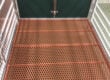
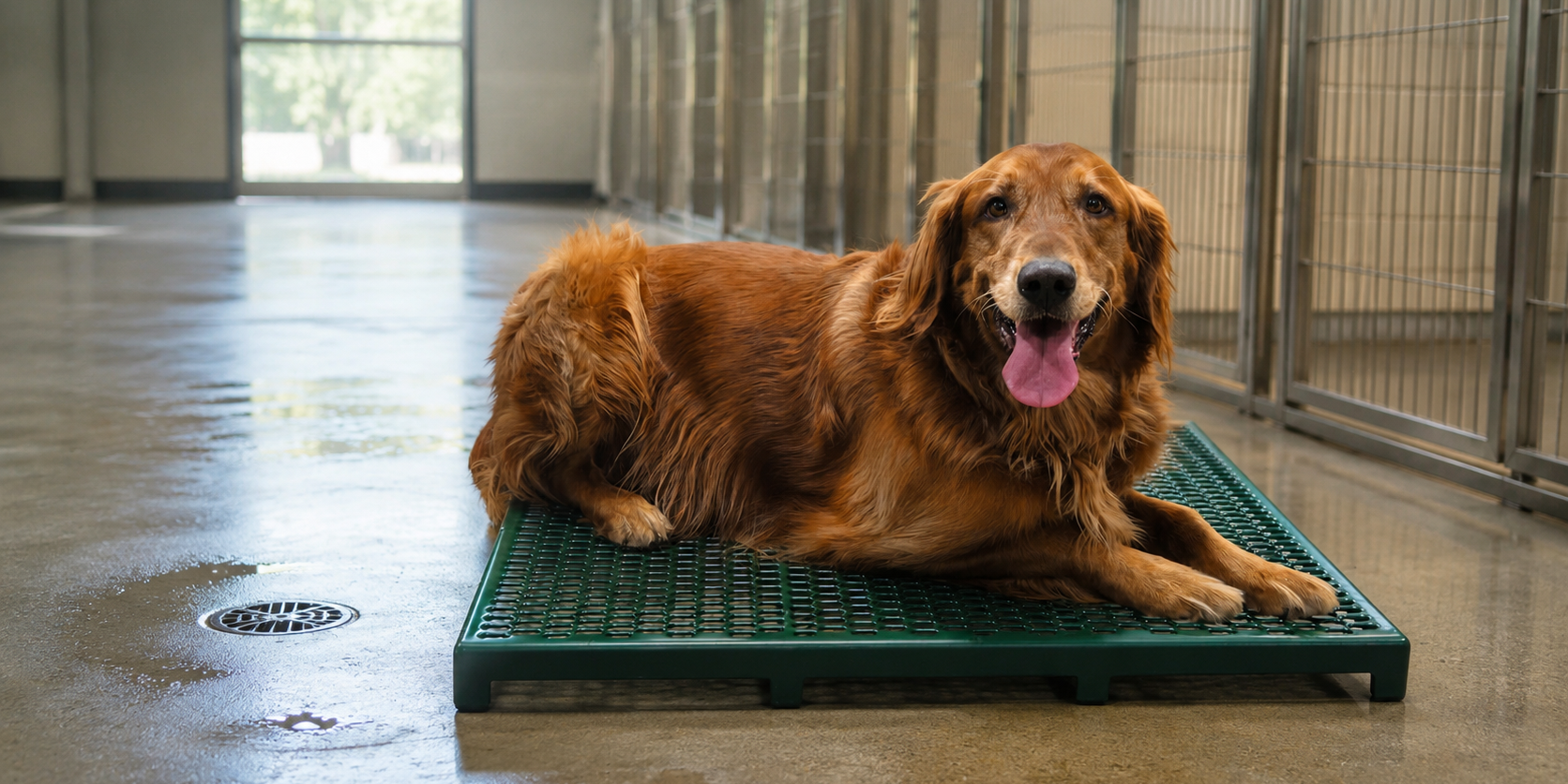
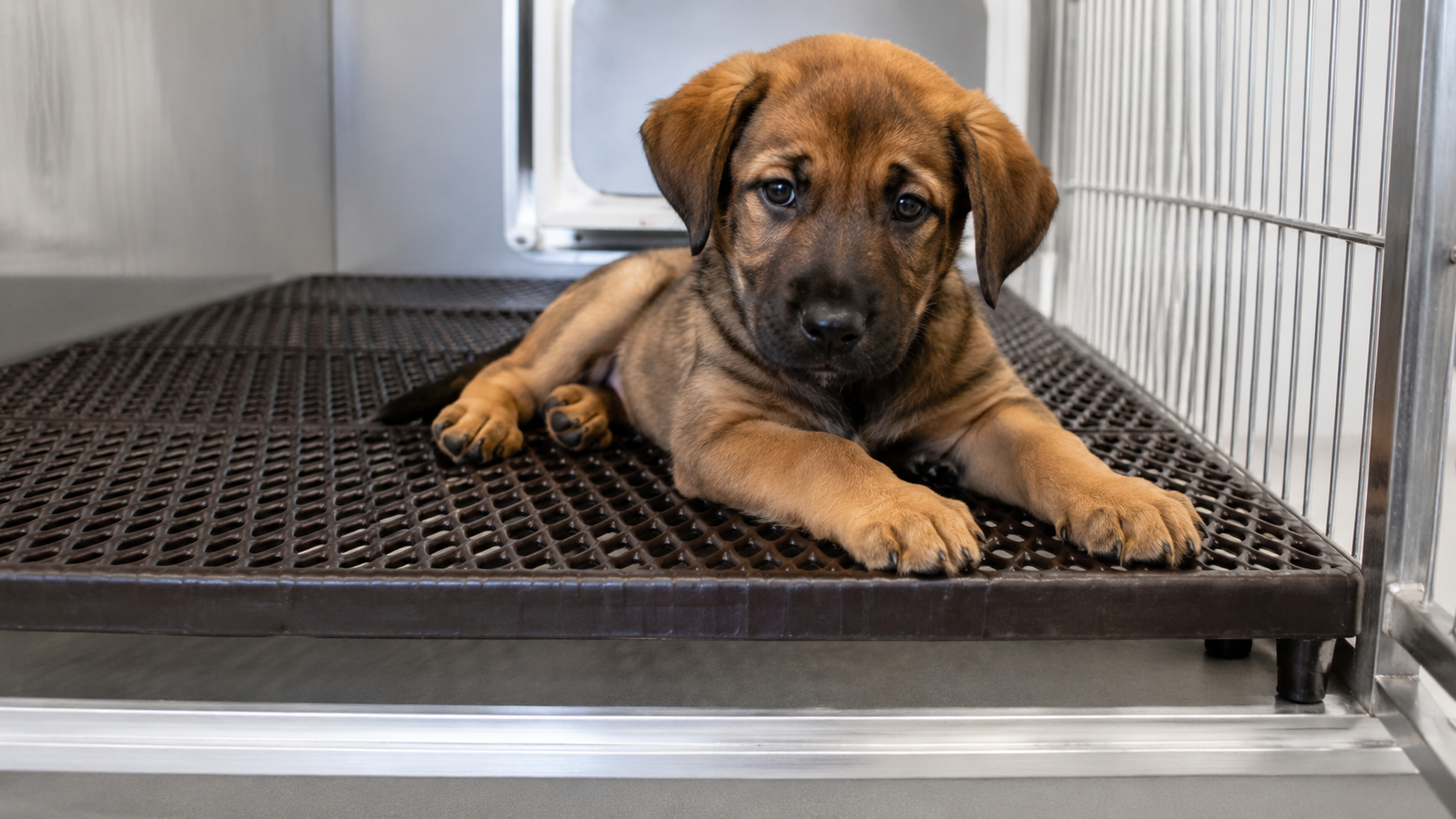
RACS raised kennel floors don’t change across the day. The plastisol-coated steel mesh allows waste and fluids to pass through continuously, so nothing pools on the surface dogs are standing or lying on. The surface the last dog of the day gets is the same surface the first one did. No absorption, no pooling, no degradation from volume.
“Metal Floors Are Uncomfortable” Is the Most Expensive Misconception in Boarding
Boarding operators who avoid metal kennel flooring are usually picturing bare stainless steel or wire grating. Cold, hard, no traction, uncomfortable for any dog spending hours in a run. That’s a reasonable objection to bare metal. It’s not a reasonable objection to plastisol-coated steel.
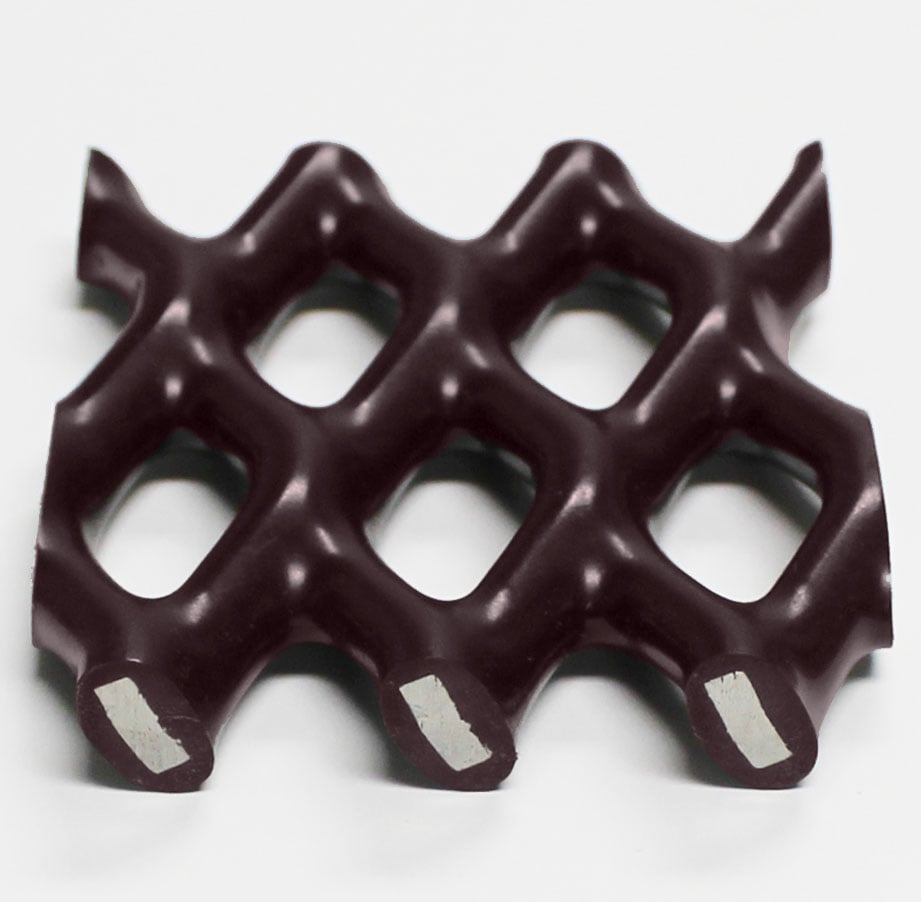
Plastisol is a thick polymer coating that fully encapsulates the steel underneath. There is no exposed metal anywhere on the product. The surface stays warm at ambient room temperature because plastisol doesn’t conduct cold the way bare steel or concrete does. Dogs aren’t lying on metal. They’re lying on a coated surface that provides consistent traction when wet or dry, doesn’t compress or shift under weight, and doesn’t develop the cold spots that bare concrete and metal create in climate-controlled facilities.
The misconception gets expensive because operators who rule out coated metal flooring end up compensating with add-ons. Rubber mats over concrete for cushioning. Supplemental bedding for warmth. Raised plastic kennel decks for drainage. Each layer solves one problem and introduces another. Bedding absorbs fluids and needs constant replacement. Rubber mats harbor bacteria underneath. Plastic kennel decks crack under heavy dogs and develop gaps where paws catch.
RACS flooring doesn’t need anything layered on top of it. The plastisol coating is the comfort surface, the sanitation surface, and the drainage surface in one system. No supplemental bedding. No mats underneath. No plastic panels that degrade over time. One product handles what three or four add-ons were trying to do separately. If you’re evaluating what to put in the bottom of a dog kennel, the answer for a commercial facility is a surface that doesn’t need anything on top of it.
What “Sanitary” Actually Means When You’re Turning Over Runs All Day
Every boarding facility can sanitize its floors. That’s table stakes. The question that separates adequate flooring from the right flooring is what happens between sanitizations. When a dog leaves a run and the next dog enters 20 minutes later, what’s living on that surface in the gap?
Pathogens that cause common boarding facility illnesses can survive on surfaces for extended periods. In a high-turnover facility, the window between dogs is the vulnerability. If the floor surface absorbs or harbors contaminants that routine cleaning doesn’t fully reach, every turnover carries risk forward to the next animal.
Rubber mats can be disinfected on the surface, but the material itself absorbs at a level that cleaning agents can’t fully penetrate over time. Sealed concrete can be disinfected when the surface is intact, but thermal expansion and daily nail wear create micro-cracks that harbor bacteria below the reach of topical disinfectants. Epoxy coatings degrade under repeated chemical exposure and UV, requiring periodic recoating that takes runs out of service. Tile and grout floors turn grout lines into bacterial reservoirs that worsen with every cleaning cycle.
RACS kennel floors are plastisol-coated steel. Non-porous, fully sealed, no exposed metal. Built-in antimicrobial protection has been independently tested to reduce E. coli and Salmonella by 99.99%. The surface doesn’t just tolerate disinfectants. It actively resists bacterial colonization between cleanings. That’s the difference between a floor that’s sanitizable on a spec sheet and a floor that stays sanitary in practice across a full day of turnover.
The raised design compounds the advantage. Waste and fluids pass through the mesh rather than sitting on the surface waiting for staff intervention. Between dogs, the run is already dry. End-of-day cleanup is a pressure wash from above. No pulling mats to scrub underneath. No waiting for concrete to dry before the next dog goes in. No grout lines to deep-clean quarterly.
For facilities with non-standard run dimensions, RACS manufactures kennel flooring and custom animal floors to exact specifications, any size up to 10 feet. One-piece construction means no seams or joints where contamination collects between runs.
Made in the U.S.A. by a direct manufacturer in Northwood, Iowa. No distributor layers between your facility and the production floor.
The Floor Should Be the Last Thing You Think About on a Full-Capacity Day
On a full day, every run occupied, intake stacked, staff stretched thin, the flooring is either solving problems quietly or creating them loudly. Rubber mats that need pulling and scrubbing are a problem. Concrete that stays wet between turnovers is a problem. Epoxy that’s scratched down to the substrate is a problem. Each one demands staff attention at the exact moment staff attention is least available.
RACS raised kennel floors are a complete raised flooring system built to stay out of the way. Comfortable for every dog without supplemental bedding. Sanitary between every turnover without manual intervention. Drainage that works whether staff are standing over it or not. Fifty years of manufacturing animal care flooring in Northwood, Iowa, built into every product that ships from the production floor to your facility.
If you’re building a new boarding facility, renovating an existing one, or replacing flooring that isn’t keeping up with your volume, contact a RACS representative to discuss kennel flooring built for commercial operations, or request a quote online.